

HERE ARE THE FRUITS OF SOME RECENT SHOOTS
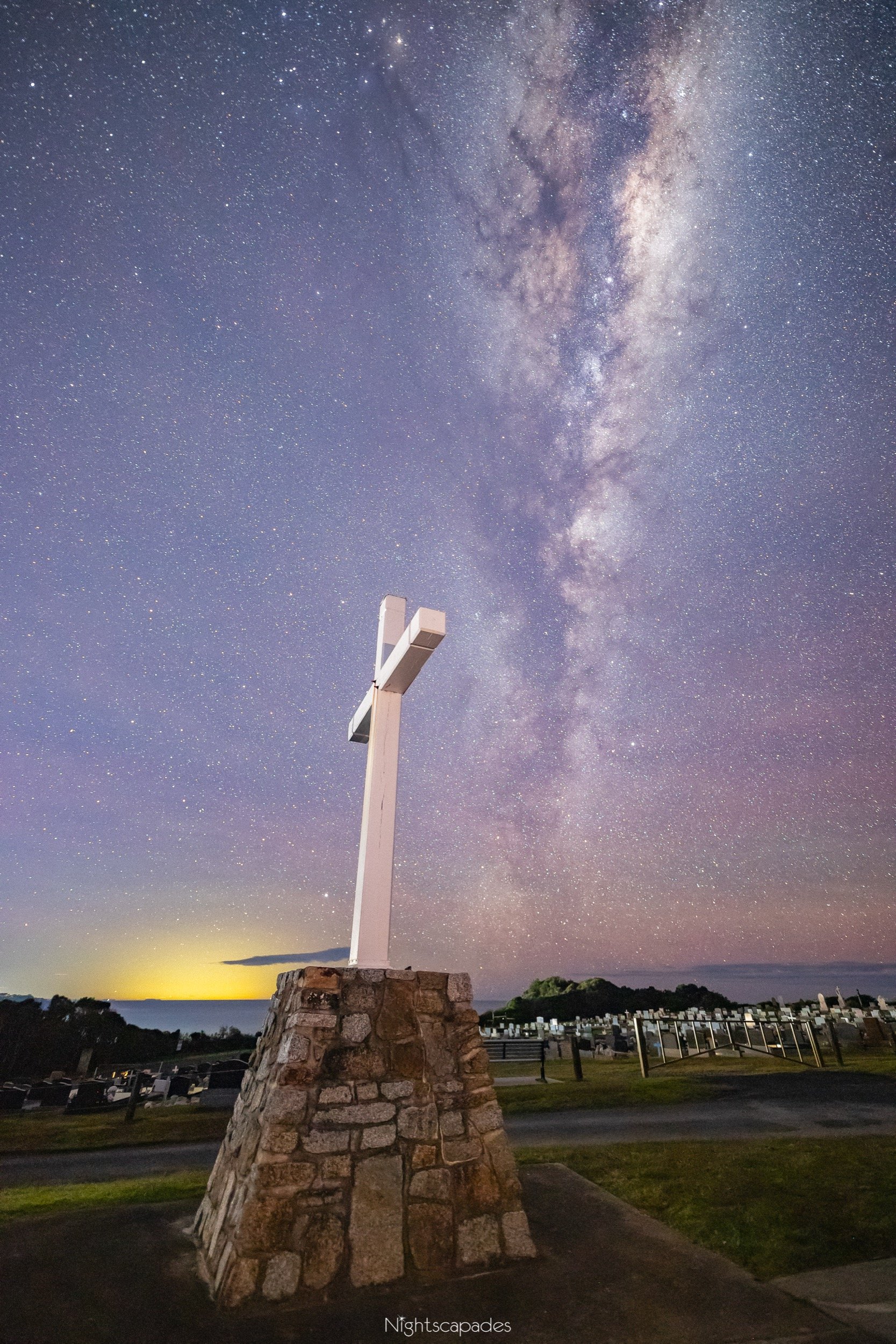
“Lest We Forget,” reads the inscription on the cross-piece of this monument inside the public cemetery at Narooma, on the south coast of New South Wales, Australia. (The inscription isn’t visible in the photo). The composition of this photo reminds me of a few things I find important. The sounds of the night—hearing the churning of the ocean on a nearby beach, and the movements of nocturnal critters doing what they do—soothe my soul. Appreciating—taking time to consider those people, past and present, whose lives and memories helped to shape my life. Looking—at the beautiful stars that hold me in wonder each time I stare at them. This photo is a single exposure, taken with my Canon EOS 6D Mk II camera and a Sigma 14mm f/1.8 lens at f/1.8, using an exposure time of 20 seconds at ISO 6400. Date photographed: 2026-07-14
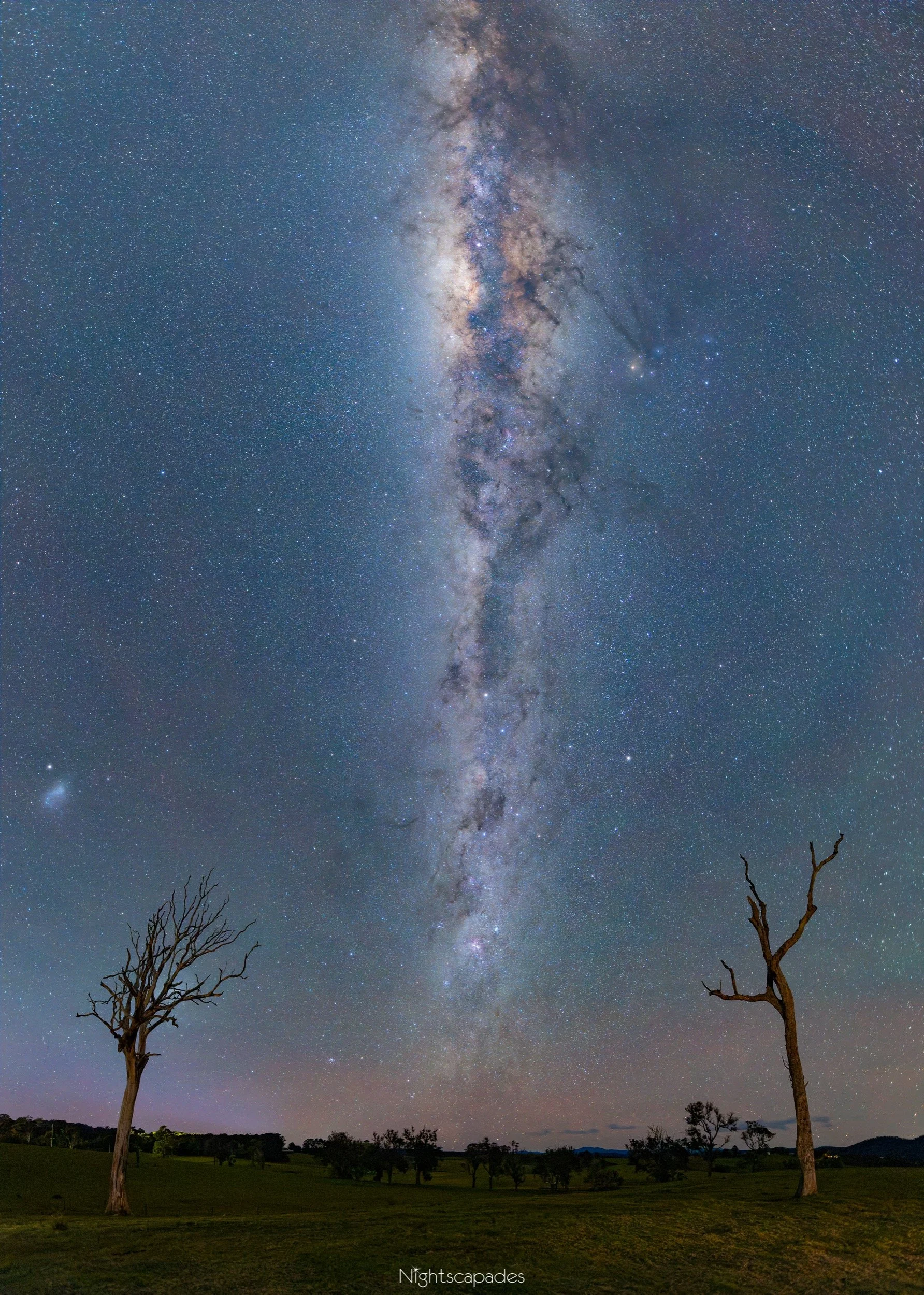
Date photographed: 2026-07-12
Location: Bodalla, NSW, Australia
One of my favourite times of year to photograph the Milky Way is in the middle of the Australian winter. The nights are long, the atmosphere is more stable than in warmer months, and our home galaxy loves to reveal its wonders to anyone who looks up. Add a Moonless night, clear skies and little to no light pollution, and you’re in for a treat. The village of Bodalla, Australia, offered me all of those in mid-July when I captured this image of the Milky Way standing on end between two wonderfully photogenic trees. Located only 700 metres (0.4 mi) from the centre of town, the paddock these trees inhabit offers a lovely view of the pastoral lands to the south. That night, the sky was alight with my favourite green hue of atmospheric airglow, and the Small Magellanic Cloud was prominent as it began another circle around the South Celestial Pole. I created this image by shooting five overlapping images, each taken with my Canon EOS 6D Mk II camera and a Sigma 14mm f/1.8 lens at f/2.2, with an exposure time of 25 seconds at ISO 6400.
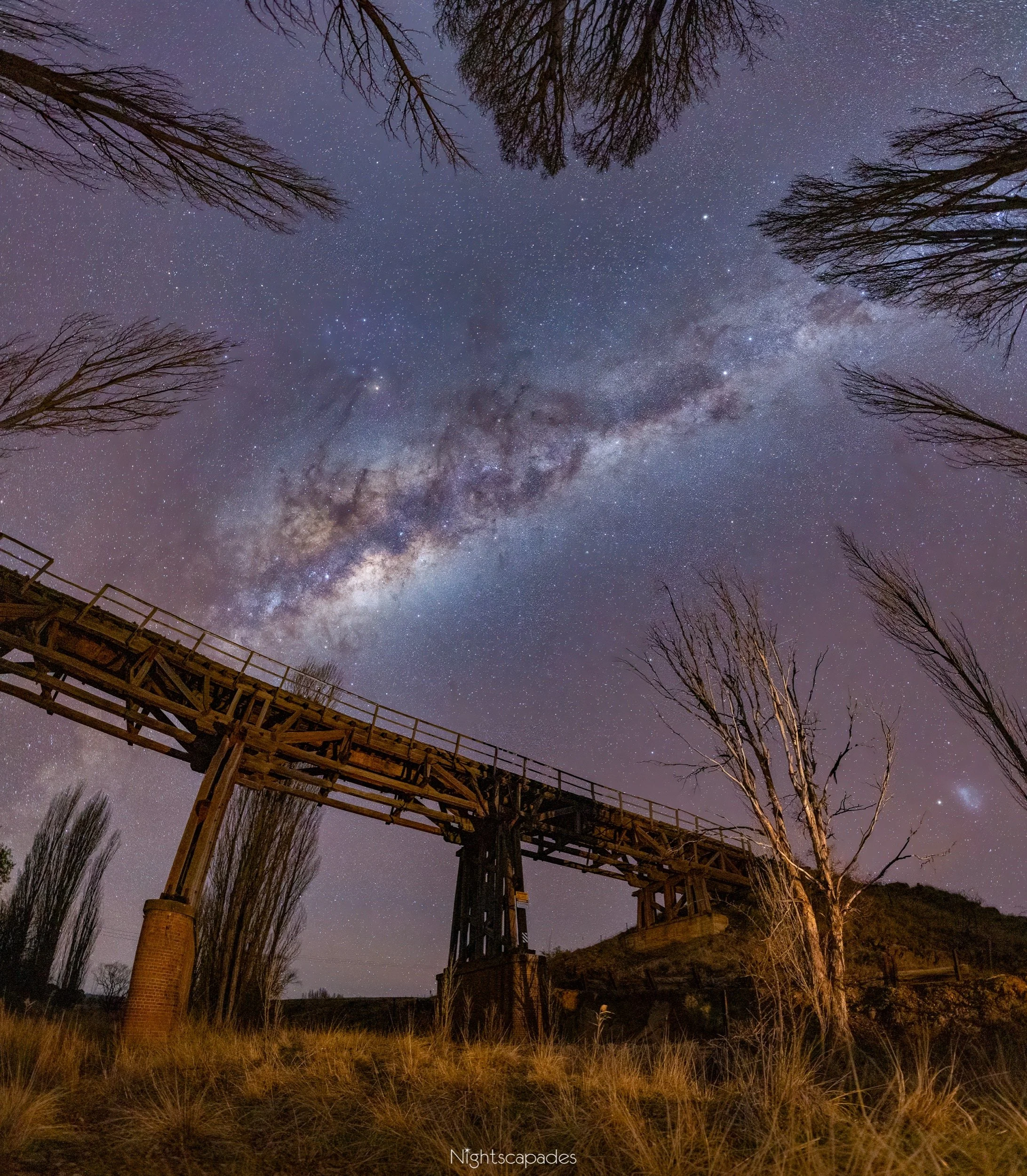
This timber railway bridge on the disused Bombala Line south of Canberra, Australia, has been on my “Want to go” list in Google Maps for about five years. In mid-July this year, I made time to drive to the site and satisfy two of the passions of my childhood and teenage years: nightscape photography and the railways of my state of New South Wales, Australia. As you come near the timber titan, you see a sign warning you of “Danger. No stopping. COLLAPSING STRUCTURE.” Heeding that advice, I parked my car 20 metres short of the abutment and scouted for a viable spot to set up my camera, tripod and LED banks. While I was down near the creek that runs under the bridge (but well back from it), I heard a loud “THUMP” while I was lining up for a shot. True to the warning, a large piece of the 137-year-old “collapsing structure” had succumbed to gravity and landed about 15 metres from where I was standing. I ended up shooting several compositions that I am happy with, and today’s post shows you my pick of the crop, with the Milky Way’s core and the Dark Emu being lauded by the poplars as they pass overhead. Each of the four images was taken with my Canon EOS 6D Mk II camera and a Sigma 14mm f/1.8 lens at f/2.2, with an exposure time of 20 seconds at ISO 6400.
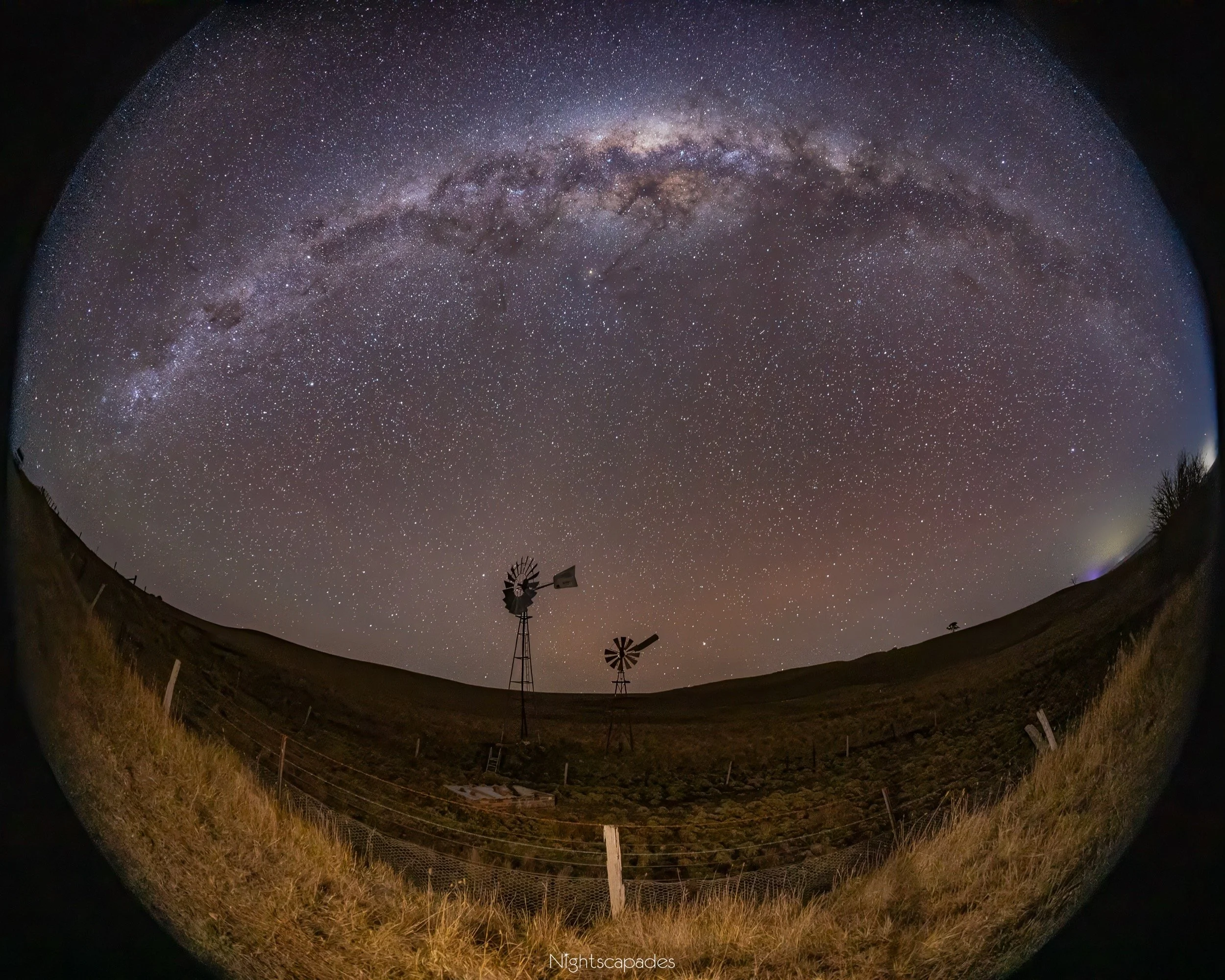
When I visited this site south of Cooma, Australia, in mid-July this year, my plan was to stay until the Milky Way was low in the western sky and to capture a multi-row panorama around 2:00 am. This fisheye-lens photo I’m posting today was taken at 11:00 pm and was meant to be a test shot to check that I was in the right place for the upcoming pano. Close to the time that I was ready to get into my car and get a couple of hours’ sleep, a sky-wide bank of cloud started to blow in from the southeast. Within about 30 minutes, the stars were no longer visible thanks to the clouds, so I went back to my hotel and got a relatively early night. I’m glad I took the test shot; otherwise, I would have gone home very disappointed. My photo was taken with my Canon EOS R camera, a TTArtisan 7.5 mm f/2.0 fisheye lens, at f/2.0, with an exposure time of 25 seconds at ISO 6400.
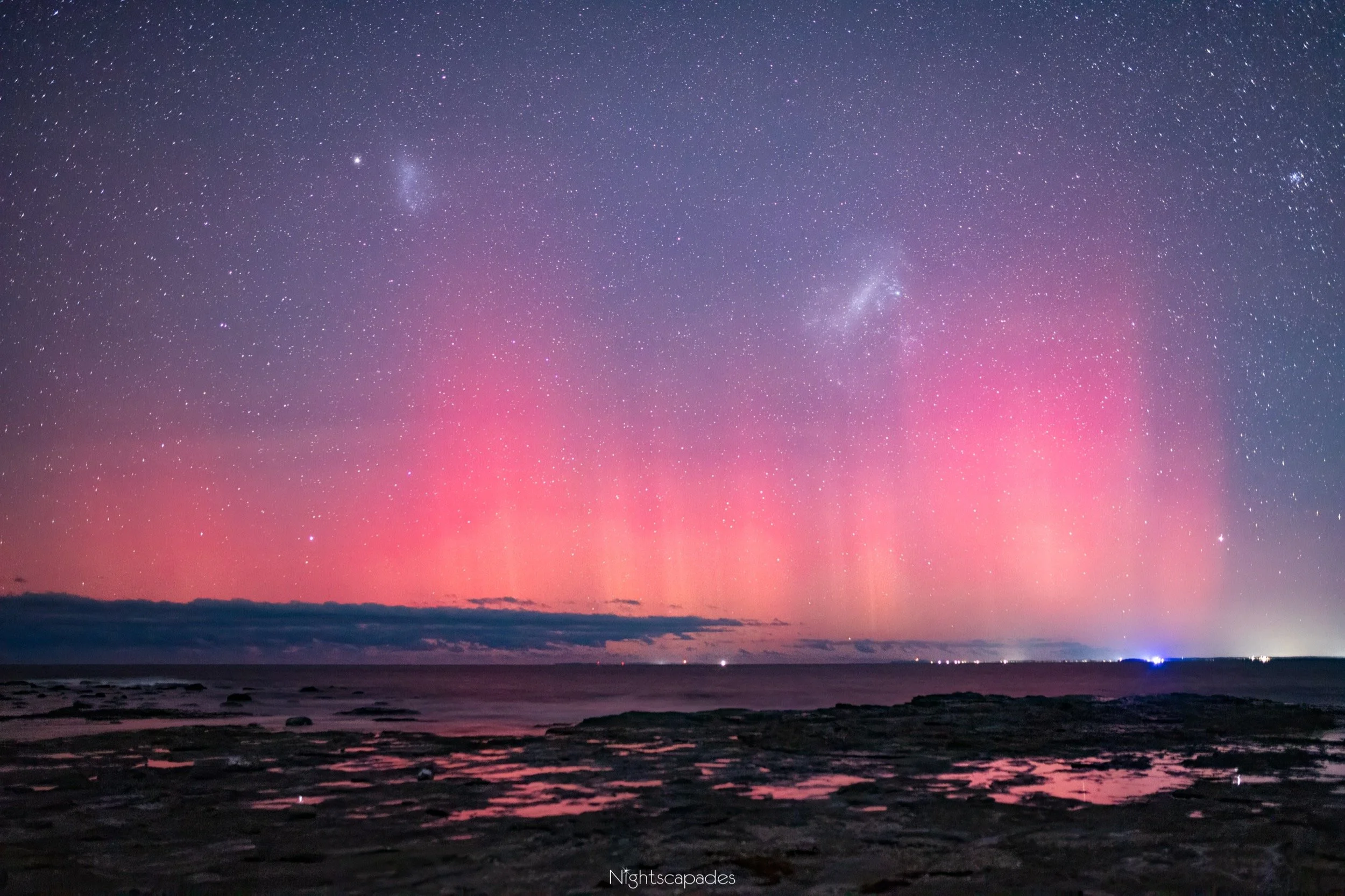
On Saturday night, the 4th of July, I drove 110 km (68 mi) south of my home in Sydney, Australia, to the seaside town of Gerroa with my good friend, Craig Barnes. “Good friend” is an understatement—we’ve been friends for 56 years! Our plan was to photograph the Milky Way rising over the Tasman Sea. Our viewfinders showed some pink and very faint auroral glow in the southern sky, but not enough to get excited about, so we got on with our Milky Way shooting. At around 8:30, half an hour before Moonrise, we could see some unusual colour in the sky to the south. We both took a few quick shots and could see that bingo, the aurora was lighting up the night. Once the Moon rose, the auroral display was washed out, but for the twenty minutes we had with the sky still dark, we got as many photos as we could, including the one I’ve posted here today. I captured this image of the Aurora Australis with my Canon EOS 6D Mk II and a Sigma 35mm f/1.4 Art lens at f/1.8, with a 10-second exposure at ISO 3200.
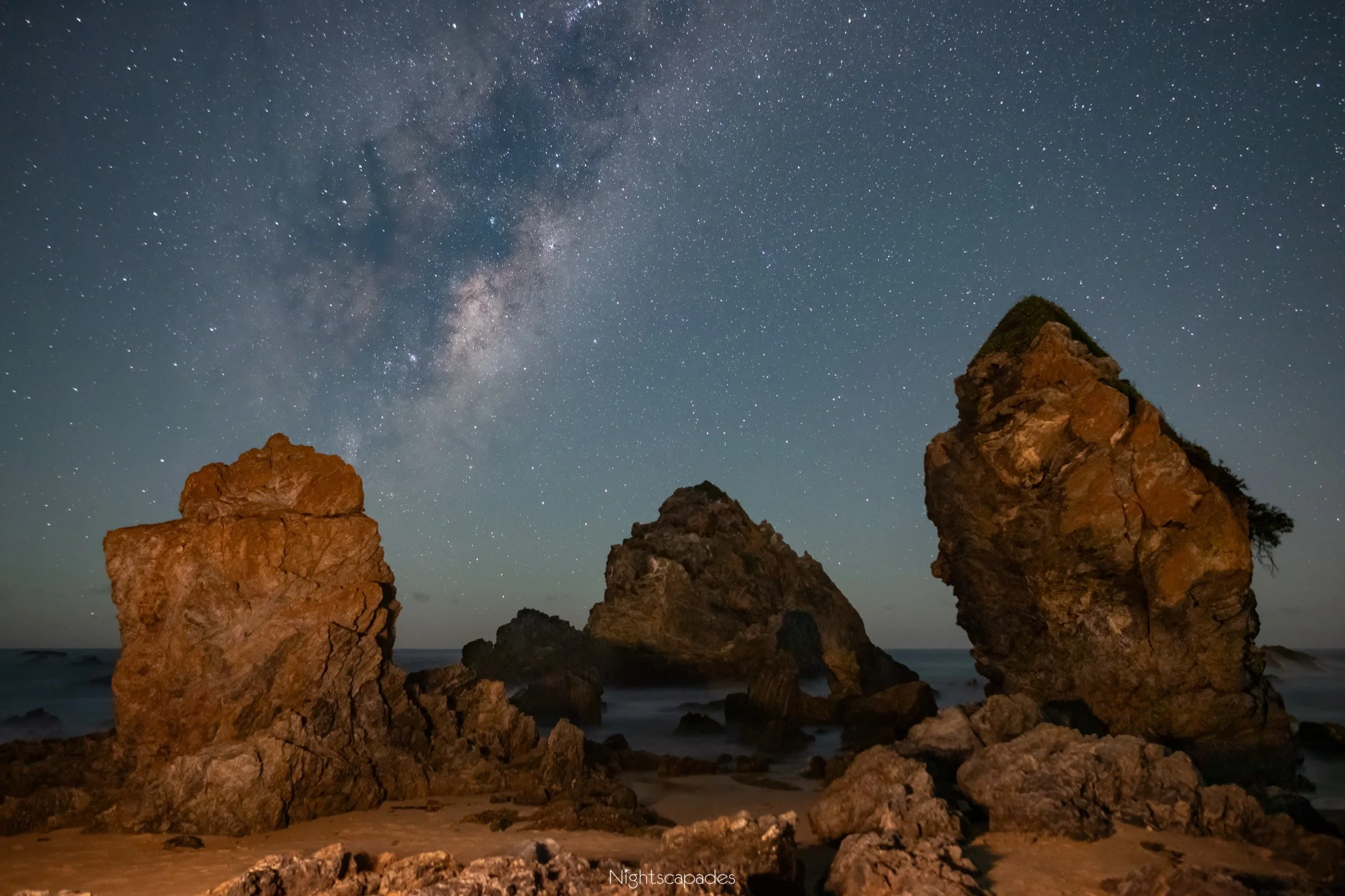
After spending a few hours with my mate Ian Williams, photographing the famous Horse Head Rock at Bermagui, Australia, one night in May 2025, we made our way back to Camel Rock Beach. That simple sentence leaves out the troubles we faced in keeping our footing in the dark, as the rising tide washed over the rocks we were cautiously crossing. One of us ended up face-down on those rocks (hint: it wasn’t Ian), trying to get back up with a 20 kg camera backpack attached. Until that night, I’d only known of those two landmarks named after living creatures. It was after I took this shot that I discovered there’s also a landform called Gorilla Rock, which you can see on the right-hand side of this scene. Since then, I’ve learned of “Croc Tail Rock” and “Dragon’s Tail Rock” along that same short stretch of coast. As the saying goes, it’s a jungle out there! My photo for today was taken with my Canon EOS 6D Mk II and a Rokinon 24mm f/1.4 lens at f/2.4, with a 13-second exposure at ISO 3200.
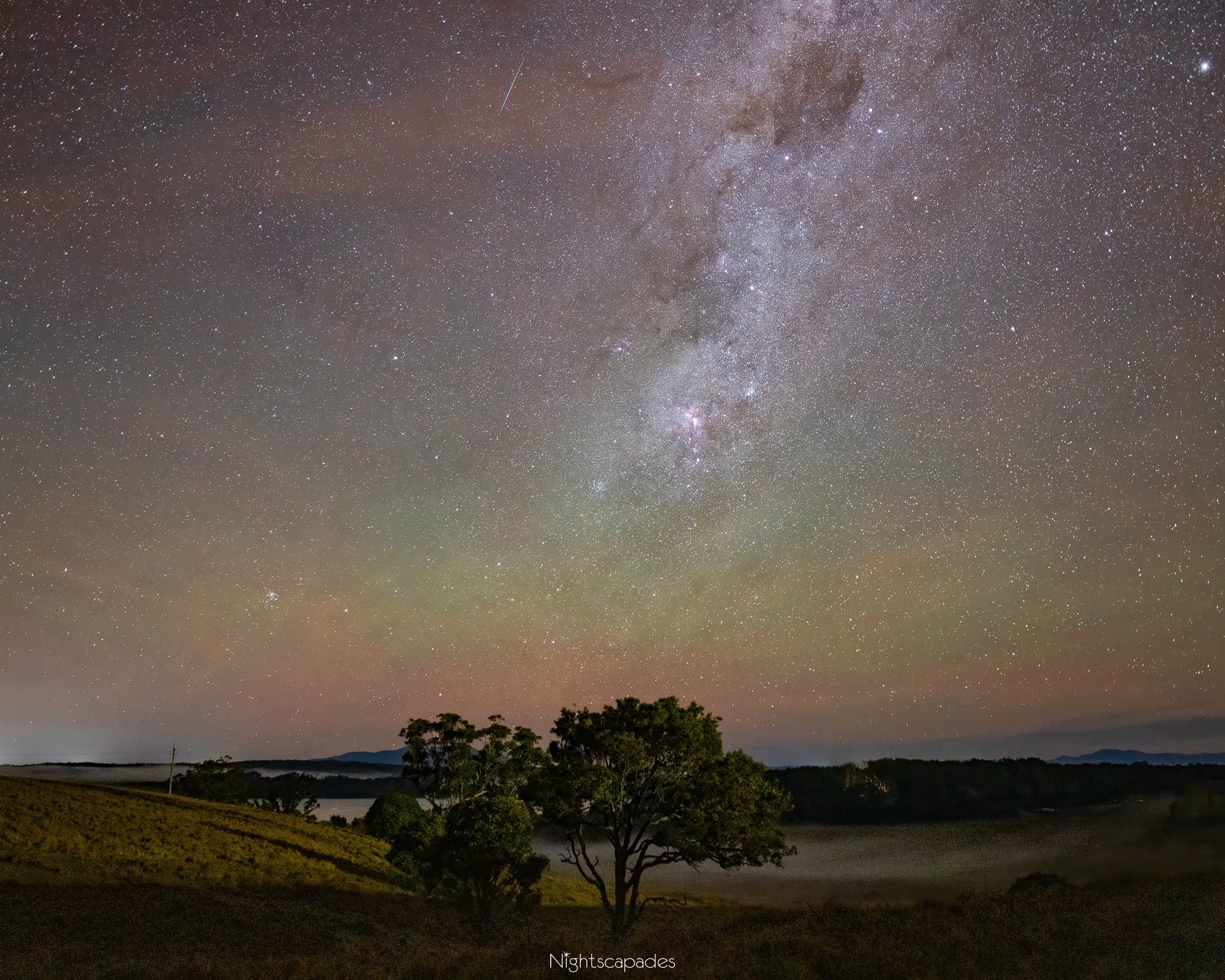
During my visit to Tuross Head, Australia, in early June, my final stop after a long day—comprising several hours of work in the morning, a 300 km drive to my accommodation, and about eight hours of photography—was at a spot with a mostly unobstructed view to the south. I had been checking my phone for Aurora alerts and noticed there might be some activity worth capturing. Since this location was on the way to where I was staying that night, I pulled over, set up my camera on a tripod, and took a few shots. There appears to be a splash of pink and red along the horizon, most likely the last display of the Aurora Australis for the night. A meteor showed its green death-flash as I had the shutter open, ending the most enjoyable, productive, and restorative nightscape photography session I’ve had in a very long time. I combined two landscape-format photos to create this 5x4 ratio image. Each frame was captured with my Canon EOS 6D Mk II camera and a Sigma 35mm f/1.4 Art lens at f/1.8, with an exposure time of 13 seconds at ISO 3200.
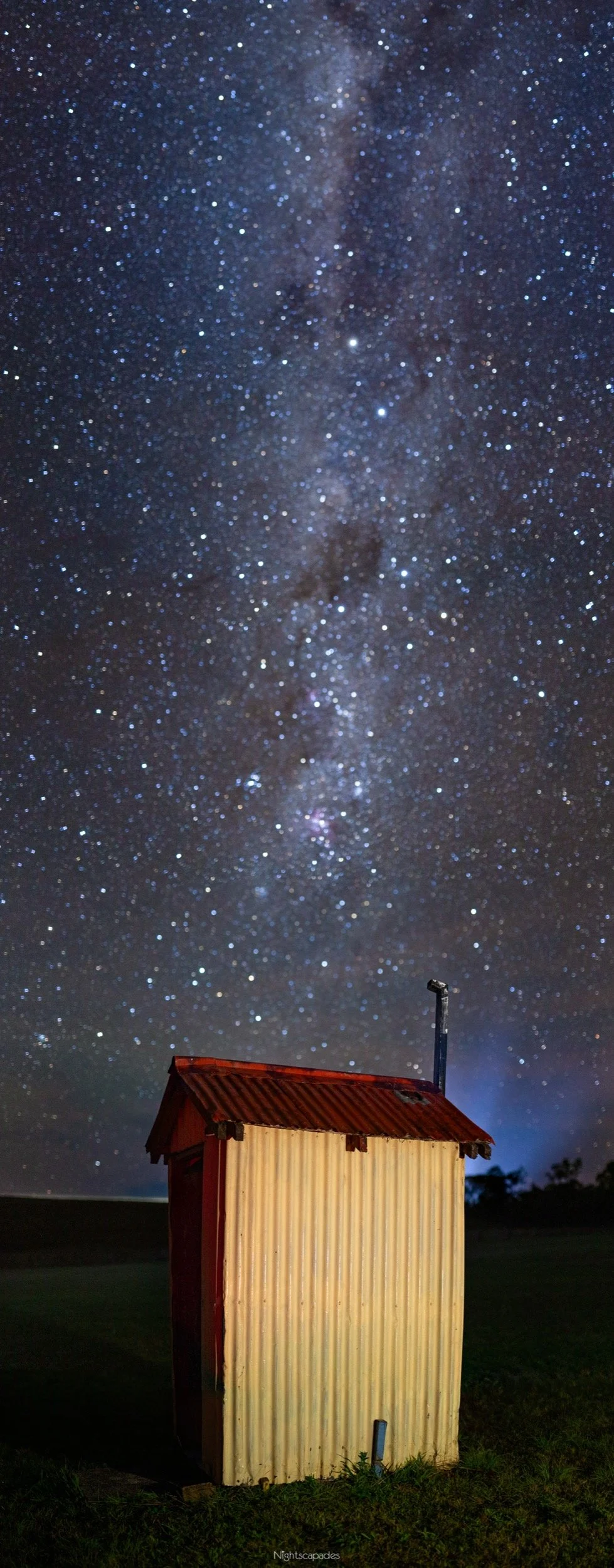
With its colourfully painted corrugated-iron walls and roof, the outhouse behind the former St. Stephen's Presbyterian Church at Coila, Australia, was a fun photo subject when I visited in mid-June of 2026. The church building has been on the site for over 120 years, but hasn’t been used for worship for several decades.
I lit the structure with an LED bank perched atop one of my tripods and set my camera’s lens so the stars of the Milky Way, including the Southern Cross and the Pointers, would be fuzzy but still visible. The headlights of a car driving along the nearby Princes Highway added some extra interest to the scene.
Shot as a six-frame vertical panorama, I had to crop the image for better viewing on social media. Each of the six shots was captured with my Canon EOS 6D Mk II camera, a Sigma 50mm f/1.4 lens @ f/1.4, using an exposure time of 6.0 seconds @ ISO 3200.
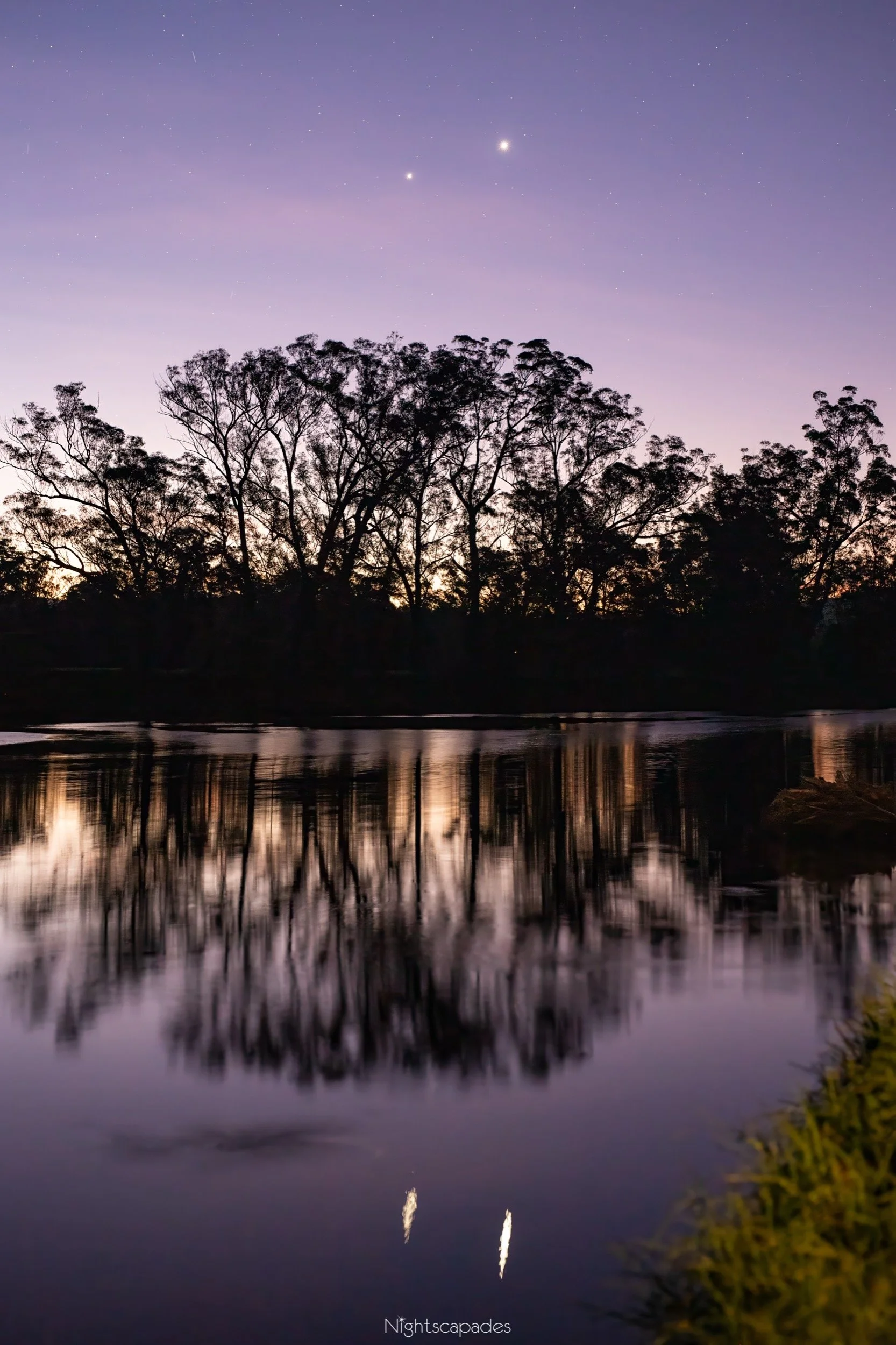
Jupiter is the largest planet in our solar system. It has 2.5 times the mass of all the other planets orbiting the Sun. Venus is the brightest planet in our solar system as seen from Earth. Permanently shrouded in clouds that reflect 70% of the sunlight they receive, the second planet from the Sun is so bright it can be visible in daylight. We have been treated to these planetary performers dancing in the northwestern sky over the past couple of months here in Australia. After many weeks of persistent clouds, I finally managed to photograph them a few weekends ago. Here are the two beautiful beacons sinking towards the horizon, their brilliance reflected in the smoothly flowing waters of the Tuross River. I captured this scene with a single 2-second exposure using my Canon EOS 6D Mk II and a Sigma 50mm f/1.4 lens at f/2.2, ISO 3200.
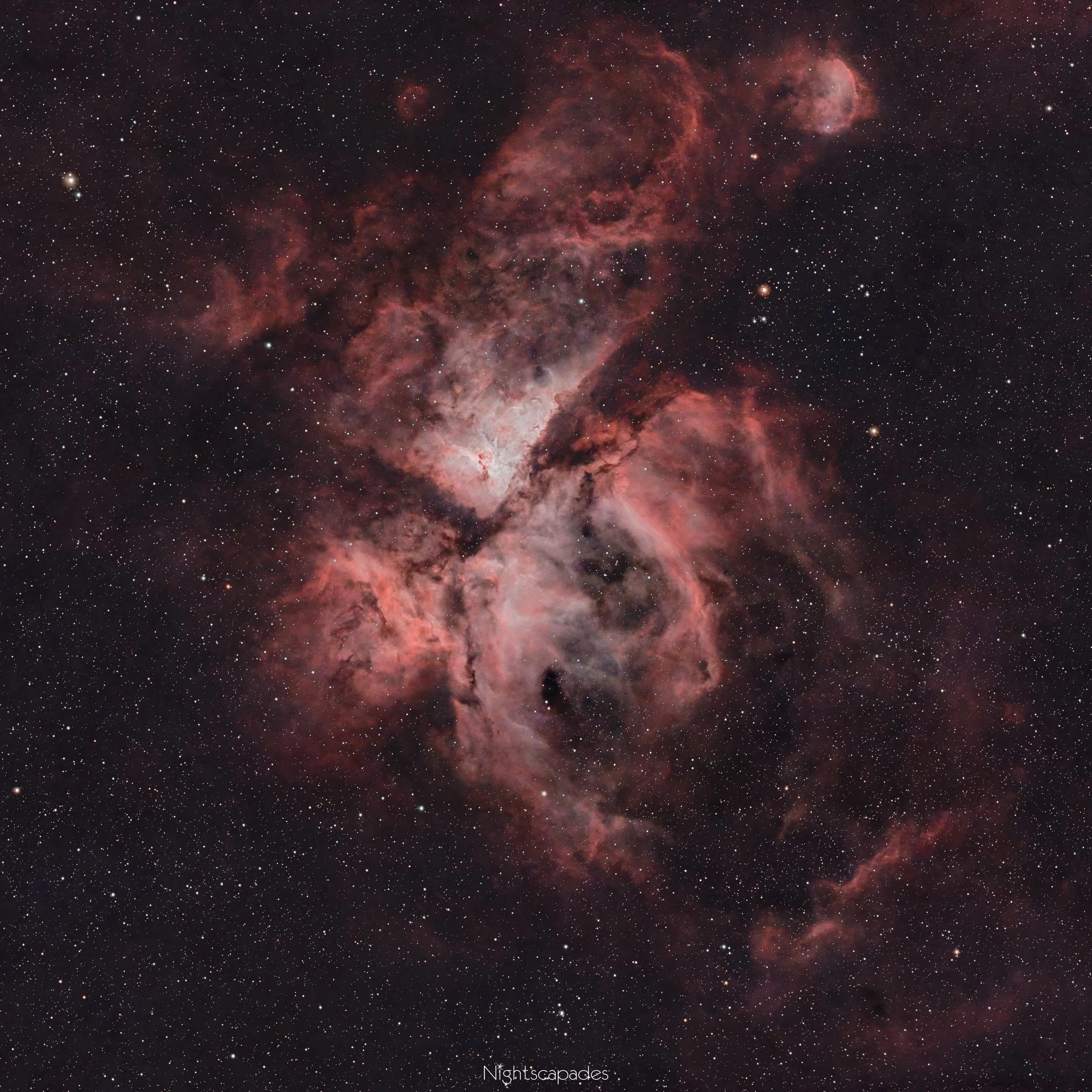
Whichever name you choose to remember this flaming flower nebula by, I hope you’re as taken in by its beauty as I am. Categorised as an emission nebula, the astronomical feature is known by several names, including the one I have always known it as: the Eta Carinae Nebula.
I shot this target from my home in the southern suburbs of Sydney, Australia, earlier in May, using my Dwarf 3 smart telescope. There’s a scale of night sky quality, the Bortle Scale, that ranks how dark the skies in your area are. A Bortle-1 sky is the darkest you can get, and a Bortle-9 rating means you’re living in a heavily light-polluted location. My suburb scores a 6 on the Bortle scale, which is bad, but not the worst. Considering that my little telescope made this photo in that bad a sky, I’m very happy with what I’ve produced.
For the record, the other names for the nebula are: the Carina Nebula; the Great Carina Nebula, NGC 3372, Caldwell 92 (or C 92). It is approximately 8,500 light-years from Earth.
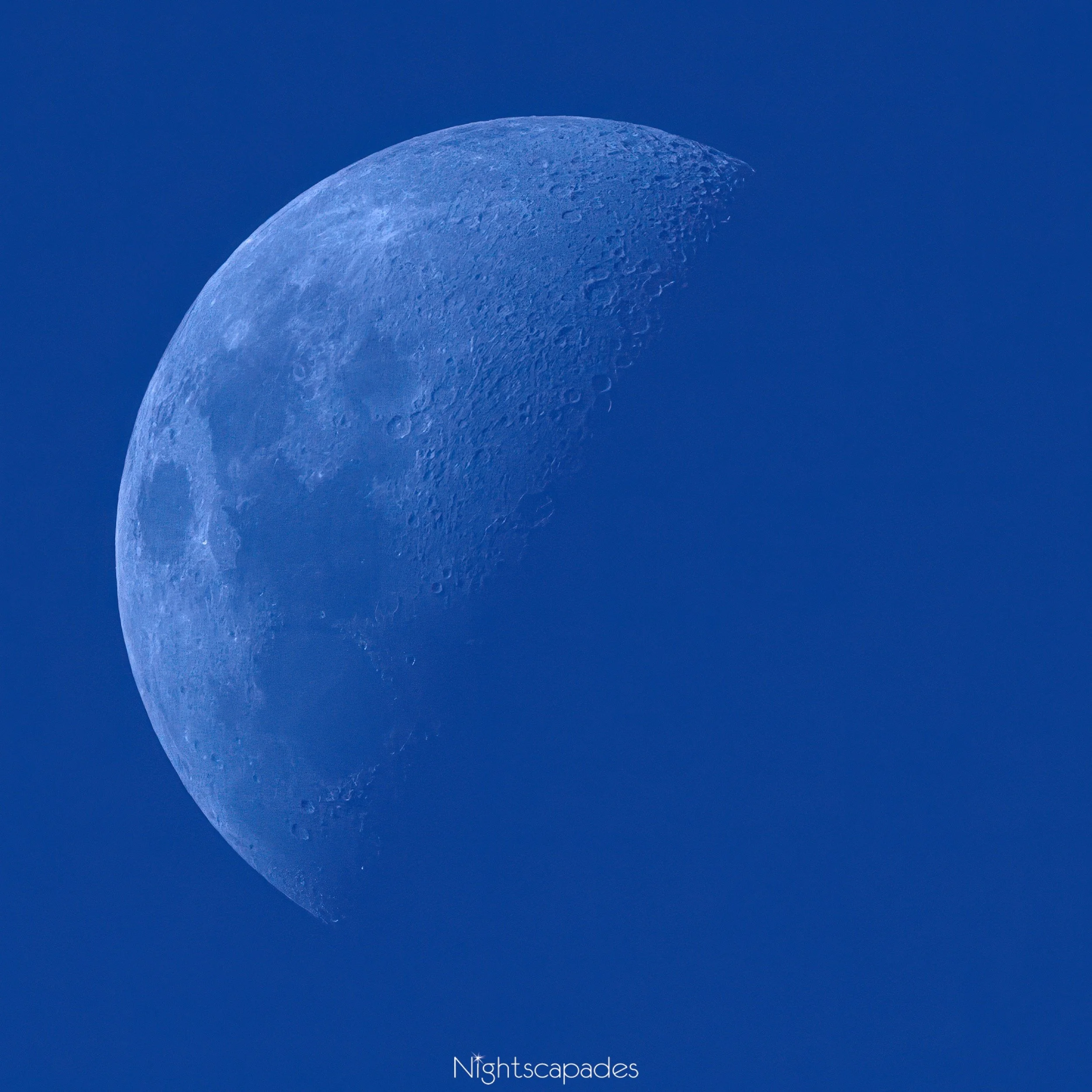
Sometimes it’s the beauty of seeing the Moon against a vibrant blue sky that moves me to shoot and post an image. I don’t think I need to add other words to this one.
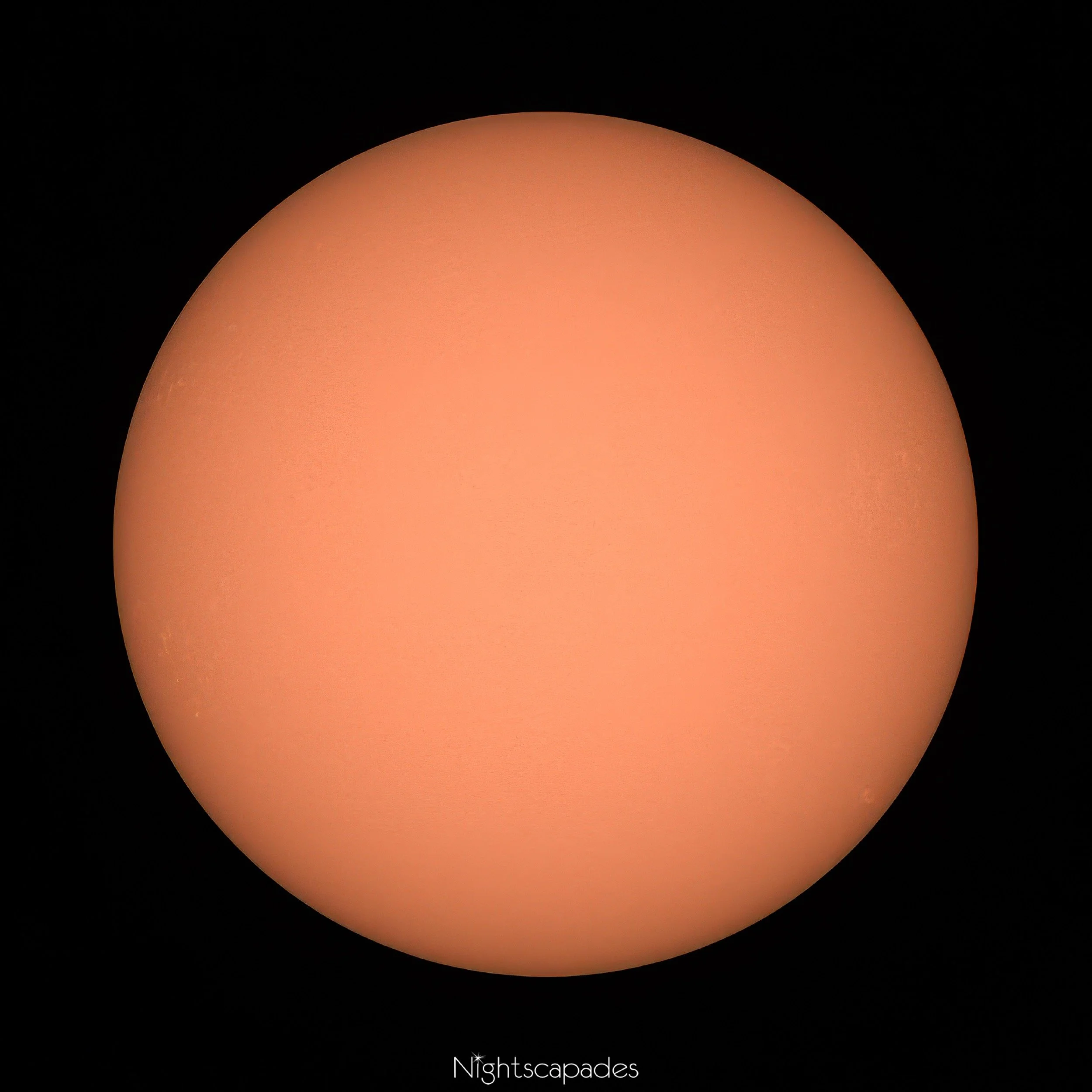
We haven’t seen many cloudless days or nights in Sydney lately, so I was happy when a brief burst of blue sky lasted long enough for me to photograph the Sun on Sunday, 22nd February. My excitement faded when I saw the images my Dwarf 3 smart telescope was producing. “Spotless,” “boring,” “bare,” and “disappointing” were a few of the words that came to mind once I downloaded this image I’m posting today. There wasn’t a sunspot to be seen! The only fact worth mentioning is that this was the first sunspot-free day since the 8th of June, 2022. That’s a total of 1355 days in a row that the Sun was showing its spots! I captured this photo of our home star with my Dwarf 3 Smart Telescope.
